Tangram World


What is the Tangram
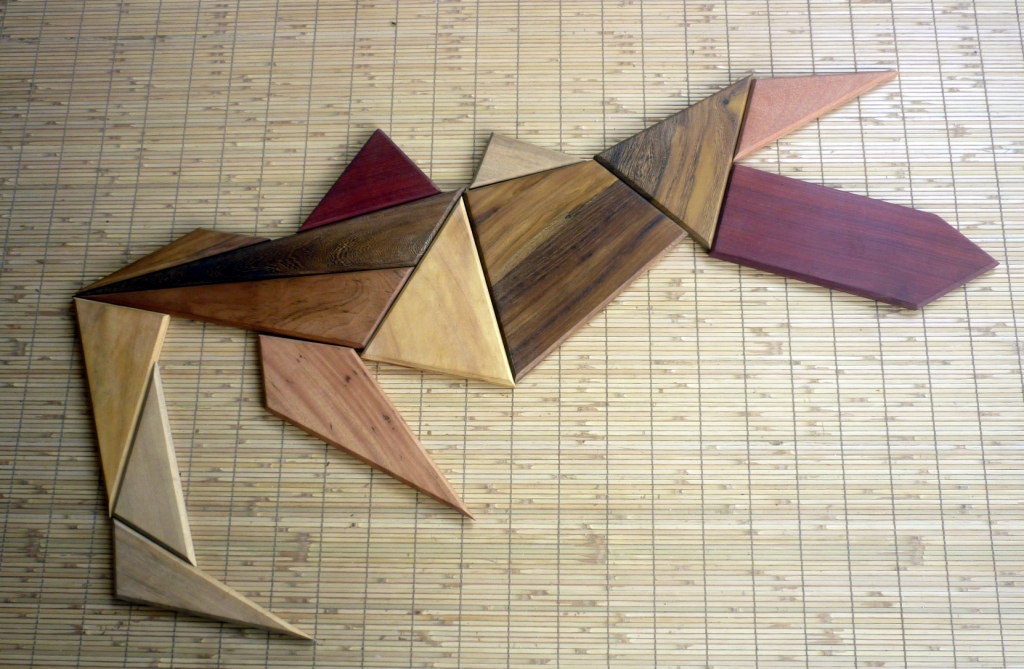
The Tangram is nowadays the most popular dissection puzzle formed from 7 polygons. The aim of the puzzle is to seamlessly arrange all the geometric pieces to form problem figures (rules of the game). More than 100 years ago, this game has been played passionately by many as entertainment, educational or mathematical tool, because it boosts shape recognition, problem solving, and pattern design skills. It is said that the Pythagorean theorem was discovered in the Orient with help of Tangram pieces...

   
The 7 polygons (see image further below) that form the Tangram are:
  • 5 right triangles: 2 small (hypotenuse of n/2 and sides of n/2√2); 1 medium (hypotenuse of n/√2 and sides of n/2); 2 large (hypotenuse of n and sides of n/√2). The large triangle is 4 times the size of the small triangle, but curiously its perimeter is only 2 times as big!
  • 1 square (side of n/2√2).
  • 1 parallelogram/rhomboid (sides of n/2 and n/2√2).
Of these 7 pieces, the parallelogram (or rhomboid) is the only piece that may need to be flipped when forming certain shapes; in fact, it has no reflection symmetry but only rotational symmetry, and so its mirror image can only be obtained by flipping it over.

Rules of the Tangram
Classic rules state that :
  • all 7 pieces must be used
  • all pieces must lie flat
  • all pieces must touch
  • no pieces may overlap
  • pieces may be rotated and / or flipped to form the desired shap
The object of the Tangram game is to put the seven geometric shapes together so as to form a given outline/silhouette.


The Tangram Legend
A legend says: “Thousands and thousands of years ago, Yu (玉龍), the Great Dragon, lived among human beings. He was venerated by them because he was 'yang', good, and was always ready to help them. One day, the God of Thunder, jealous of the offerings the men brought to Yu, in a moment of anger, crushed the sky with his hatchet. Consequently, the sky fell on the Earth in seven pieces black like coal. The light disappeared taking with it all existing things.
Yu at first felt sad for the world, and then felt nostalgic. Therefore, he picked up the seven black pieces of the sky and in memory of the former world, began to reassemble different kinds of shapes: animals, plants and human beings that had disappeared. But every time he finished a shape, a shadow left it and wandered the deserted world crying about its misfortune. The complaints arrived until the ears of the God of Thunder who was touched, and to remedy the harm he caused, he pulled from every shadow the body of a living being to repopulate the Earth. From that time on, the shadow faithfully follows every move we do and with the seven pieces of the sky, called Qi Qiao Ban (literally 'seven boards of cunning'), everything on Earth can still be shaped”.

Tangram Variants


Ostomachion is a puzzle that is tightly tied with Archimedes, although it may be older than Archimedes (the puzzle is also known as loculus Archimedius or Archimedes' box). In any case, ostomachion is apparently most known from the mathematical study by Archimedes. It is a puzzle made of 14 polygons, 13 of which are different and two are the same. Those 14 polygons (11 triangles, 1 pentagon and 2 quadrangles, originally made of bone) can be assembled in a square, as is shown in the image below.

A question regarding the number of ways in which one can assemble the square from the given elements immediately arises. The answer is  536 without rotations and reflections. It is obvious that any assembly of the square can be rotated three times by 90 degrees, so that one gets the same square each time, formally differently assembled. Therefore, the rotational multiplicity of the assembly is 4. Ostomachion is, besides for interesting mathematics it represents, perhaps better known (and can be understood in such a way) as a set of elements that one can use to form interesting shapes. Such interpretation of ostomachion is probably best suited to children.One form of play to which classical texts attest is the creation of different objects, animals, plants etc. by rearranging the pieces: an elephant, a tree, a barking dog, a ship, a sword, a tower etc.


The Towers of Hanoi


Le problème des tours de Hanoï est un jeu de réflexion imaginé par le mathématicien français Édouard Lucas, et consistant à déplacer des disques de diamètres différents d'une tour de «départ» à une tour d'«arrivée» en passant par une tour «intermédiaire» et ceci en un minimum de coups, tout en respectant les règles suivantes: on ne peut déplacer plus d'un disque à la fois, et on ne peut placer un disque que sur un autre disque plus grand que lui ou sur un emplacement vide.


Résoudre le problème de la Tour de Hanoï à trois disques est une tâche facile pour un adulte. On identifie assez aisément que le premier sous-but consiste à placer le grand disque à droite. Pour cela, l’emplacement de droite doit être libre et les deux autres disques doivent être sur l’emplacement du milieu. Il faut donc commencer par mettre le petit disque à droite, ensuite le disque moyen au centre et enfin le petit disque au centre. Pour parvenir à ce premier sous but, une planification n’est pas nécessaire, il n’est même pas besoin d’un raisonnement explicite, une simple anticipation perceptive suffit, d’autant que le nombre d’action à anticiper ne dépasse pas les capacités de la mémoire de travail.
  • Pour 3 disques, leurs déplacements sont faisables au minimum en 7 coups.
  • Pour 4 disques, leurs déplacements sont faisables au minimum en 15 coups.
  • Pour 5 disques, leurs déplacements sont faisables au minimum en 31 coups.
  • Pour 6 disques, leurs déplacements sont faisables au minimum en 63 coups.
  • Pour 7 disques, leurs déplacements sont faisables au minimum en 127 coups.
  • Pour 8 disques, leurs déplacements sont faisables au minimum en 255 coups.
On voit aisément que la tour de Hanoï peut être résolu en 7 coups, ce que font effectivement la plupart des adultes et leur donne le sentiment que cette situation n’est pas vraiment un problème, tant la procédure est facile à trouver. Il en va tout autrement de la Tour de Hanoï à 5 disques. Pour mettre le disque numéro 4 au milieu, il faut que les disques 3, 2 et 1 soient à droite, ce qui suppose que l’on commence par y mettre le disque 3 et donc que les disques 1 et 2 soient au milieu, ce qui n’est possible que si on a commencé par mettre le disque 1 à droite et le disque 2 au milieu.  

On voit bien que la résolution de ce problème ne peut plus reposer seulement sur une anticipation perceptive et que les capacités de la mémoire de travail vont rapidement se trouver dépassées. Ainsi, pour déplacer le plus grand disque (ce qui constituait le premier sous-but dans la tour à trois disques), il faut construire quatre sous-buts en appliquant à chaque fois la même règle : Pour mettre un disque à un emplacement, il faut que tous les autres disques soient à un emplacement différent de celui où l’on veut mettre le disque. Ce qui constitue la difficulté de la tour de Hanoï à cinq disques, c’est le nombre d’opération de raisonnement nécessaire pour parvenir à identifier les sous buts, autrement dit la complexité de la stratégie à mettre en œuvre.


Raisonnement mathématique par tâtonnements :

Désignons la suite Tn le nombre minimal de déplacement nécessaire pour bouger une tour de Hanoï de taille n d'un axe à un autre.

Si la tour n'est composée d'aucun disque, il nous faudra aucun mouvement pour la déplacer. Donc T0=0.

Si la tour est composée d'un seul disque, il nous faudra un coup au minimum pour la déplacer. Donc T1=1.

On a T0, on a T1. Il est donc temps de généraliser à n'importe quel n ! Passons donc à Tn.
Une stratégie possible pour déplacer une tour de taille n, c'est de d'abord déplacer les n-1 plus petits disques sur le deuxième axe, de déplacer le plus grand des disques sur le troisième axe, puis de déplacer la tour du deuxième axe sur le grand disque, sur l'axe 3.


Dans le cas n=2, par exemple : on déplace le petit disque sur l'axe 2 (1 coup), on déplace le grand disque sur l'axe 3 (2 coups) puis on déplace le petit disque sur l'axe 3 (3 coups). Donc T2≤3 ! (On met le signe ≤ car on n'est pas encore certains qu'il n'y a pas une solution plus rapide)

Dans le cas n=3 : on déplace les deux plus petits disques sur l'axe 2 (3 coups), on déplace le grand disque sur l'axe 3 (4 coups) puis on déplace les deux disques de l'axe 2 sur l'axe 3 (7 coups). Donc T3≤7.

Dans le cas général, avec notre stratégie : on déplace les n-1 plus petits disques sur l'axe 2 (Tn-1 coups), on déplace le grand disque sur l'axe 3 (Tn-1 +1 coups) puis on déplace les n-1 plus petits disques sur l'axe 3 (2.Tn-1+1 coups).
On a alors la formule générale : Tn≤2.Tn-1 +1 (Formule qui permet de majorer le nombre minimal de coup)
Est-il possible de le faire en moins de coups ? Et bien, malheureusement, non ! En effet, il faut à un moment ou à un autre déplacer le plus grand des disques, et on ne peut le déplacer que si tous les disques sont bien rangés en position centrale (sinon, il faudrait mettre le grand disque sur un plus petit). Il faudra donc T_n-1 déplacements pour mettre les n-1 plus petits disques au milieu, 1 déplacement de plus pour déplacer le grand disque, et redéplacer la tour centrale sur le grand disque en T_n-1 déplacements. Moralité : Le nombre minimal de mouvement Tn est plus grand que 2.Tn-1 +1.
On en conclut :
Cette relation permet de calculer Tn seulement si on connaît la valeur de Tn+1. Puisque l'on connaît T_0, on peut calculer n'importe quel Tn. Une formule de ce genre est appelée "relation de récurrence".

Pour connaitre le nombre de mouvements nécessaires aux prêtres pour bouger la Tour de Hanoï, il ne reste plus qu'à calculer T64 !
T0 = 0
T1 = 2×0 + 1 = 1
T2 = 2×1 + 1 = 3
T3 = 2×3 + 1 = 7
T4 = 2×7 + 1 = 15
T5 = 2×15 + 1 = 31
T6 = 2×31 + 1 = 63
T7 = 2×63 + 1 = 127
T8 = 2×127 + 1 = 255 (Il faut 255 coups pour déplacer la tour de Hanoï!)

Tai Shogi - 泰将棋, the East is Red


Tai Shogi has the notoriety of being the largest known historic chess variant in the world. This game was probably invented before the end of the sixteenth century. Tai Shogi has been invented by some recreational megalomaniac and for good reason. This huge game is played on a twenty-five by twenty-five board and each player has a grand total of one hundred seventy-seven pieces. Counting promotion values, one hundred and one different values exist in this game.

Objective
The game is played on a 25x25 square board, and each player manipulates 177 pieces. The pieces in Tai Shogi are flat and wedge shaped, with a uniform colour and the names printed in Japanese (the promoted value written in a different colour on the opposite side). Pieces point forward to indicate the ownership. To avoid confusion, one side is known as "white" and the other as "black". Pieces are made of wood.
The game is played like most other chess-like games, with the players making alternate moves. Some pieces can move twice, such as the Lion and Furious Fiend, but most can only make a single move.

The object of the game is to capture both the opposing Emperor AND the Crown Prince. Both pieces must be captured to win. Also, if a player has promoted his Drunk Elephant to another Crown Prince, that must also be taken.
One game may be played over several long sessions and require each player to make over a thousand moves.

The game is played without drops, and uses a promotion-by-capture rule.

The objective of the game is to capture the opponent's emperor and crown prince (or princes). When the last of these is captured, the game ends. There are no rules for check or checkmate; however, in practice a player resigns when checkmated.

Game equipment
Two players, Black and White, play on a board ruled into a grid of 25 ranks (rows) and 25 files (columns), for a total of 625 squares. The squares are undifferentiated by marking or color.
Each player has a set of 177 wedge-shaped pieces of 93 types. In all, the players must remember 99 moves for these pieces. The pieces are of slightly different sizes.


Initial Setup
click the image to enlarge :

Pieces & Movements
row 1   -   row 2 -   row 3   -   row 4   -   row 5 

Tai Shogi : row 1

Pieces and Movements

The Lance (L) can move any number of free squares straight forward but can move in no other direction. An unpromoted lance that reaches the farthest rank is trapped.
The Turtle-Snake (TS) can move any number of unobstructed spaces diagonally forward or orthogonally backward, move up to two squares diagonally backward, or move one square orthogonally forward.
The Whale (W) can move any number of free squares directly forward or backward; or It can move any number of free squares diagonally backward.
The Flying Dragon (FD) can move one or two squares along one of the four diagonal directions. Because it cannot move orthogonally, a flying dragon can only reach half the squares on the board.
Promotion : Dragon King (DK)
The Goblin (LO) can move any number of free squares along one of the four  diagonal directions, then (optionally) turn 90° and move any number of free squares in a perpendicular diagonal direction; or, It can step one square in one of the four orthogonal directions.
The Dove (D) can move one or two squares in one of the four orthogonal directions; or it can move one to five squares in one of the four diagonal directions.
The Rook (R) can move any number of free squares along any of the four orthogonal directions.
The Dragon Horse (DH) can move any number of free squares along any of the four diagonal directions; or It can move one square in any orthogonal direction.
The Dragon King (DK) can move any number of free squares along any of the four orthogonal directions; or, It can move one square in any diagonal direction.
The Free King (FK) can move any number of free squares along any one of the eight orthogonal or diagonal directions.
The Gold General (G) -  can step one square in one of the four orthogonal directions; or, One square diagonally forward, giving it six possibilities.
The Deva (DV) has asymmetric options for movement. It can step one square diagonally forward, in either direction; or, One square orthogonally to the left; or, One square diagonally backward to the right.
Promotion : Teaching King
The Emperor (E) is the most important and the most powerful piece. It has the most wide ranging move of any piece: the Emperor may move instantly to any square on the board, regardless of any pieces in the way. The only restriction to this move is that the Emperor cannot capture a piece that is protected by another piece. "Protected" means that any adjacent pieces have the ability to move to the square the protected piece is on.The Emperor must be captured in order to win the game, and it seems the only way to do it is to use your own Emperor, by first knocking out its defenders, leaving the Emperor helpless, then going in for the kill.
The Dark Spirit (DS) has asymmetric options for movement. It can step one square diagonally forward, in either direction; or, one square orthogonally to the right; or, one square diagonally backward to the left.
Promotion : Buddhist Spirit
The White Tiger (WT) can move any number of free squares directly forward or backward; or, diagonally forward to the left; or, It can move one or two squares orthogonally sideways; or, It can step one square diagonally forward to the right.

Tai Shogi : row 2


Pieces and Movements


The Reverse Chariot can move any number of free squares directly forward or backward.
The Side Dragon can move any number of free squares orthogonally forward or sideways; or, It can move one square directly backward.
The Soaring Eagle can move any number of free squares in a straight line in any direction except the forward diagonals; or, like Lion move, It can move or jump one or two squares along either forward diagonal, potentially capturing two pieces.
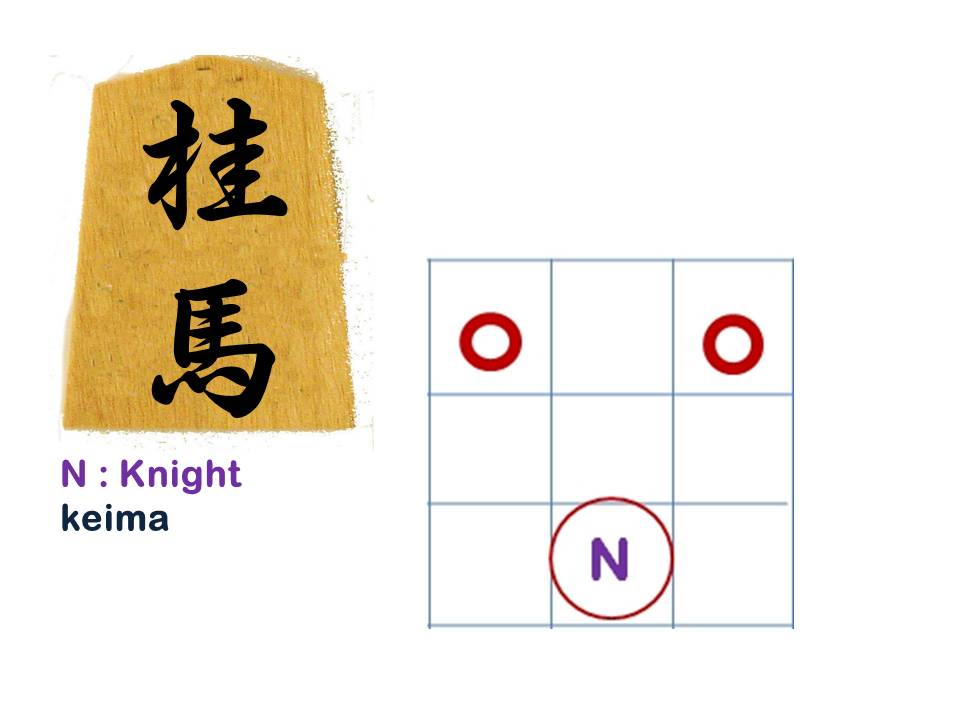
The Knight has an unusual move: it moves one space forward, then one space diagonally, jumping over a piece if necessary. The knight jumps at an angle intermediate between orthogonal and diagonal, amounting to one square forward plus one square diagonally forward, in a single motion, ignoring any intervening piece. That is, it has a choice of two forward destinations. An unpromoted knight that reaches one of the two farthest ranks is trapped.
The Poisonous Snake may jump to the second square orthogonally forward or diagonally backward or move to the first square sideways.
Promotion : Hook Mover
The Free Dream-Eater can move any number of free squares in the two forward diagonal directions; or It can move any number of free squares directly forward or backward; or It can move one to five squares orthogonally sideways.
The Bishop can move any number of free squares along any of the four diagonal directions. Because it cannot move orthogonally, an unpromoted bishop can only reach half the squares on the board.
The Fierce Eagle can move one or two squares orthogonally to either side or diagonally backwards; or,  It may step one square in any of the three forward directions.

The White Elephant can move any number of free squares diagonally backward; or, It can move one or two square in one of the other six diagonal or orthogonal directions.
The Free Demon can move any number of free squares in the two forward diagonal directions; or, It can move any number of free squares orthogonally sideways; or, it can move one to five squares directly forward or backward.
The Silver General can step one square in one of the four diagonal directions; or, One square straight forward, giving it five possibilities.
The Left General can move one square in any direction except orthogonally left. It is called the left general because it guards the left side of the board.
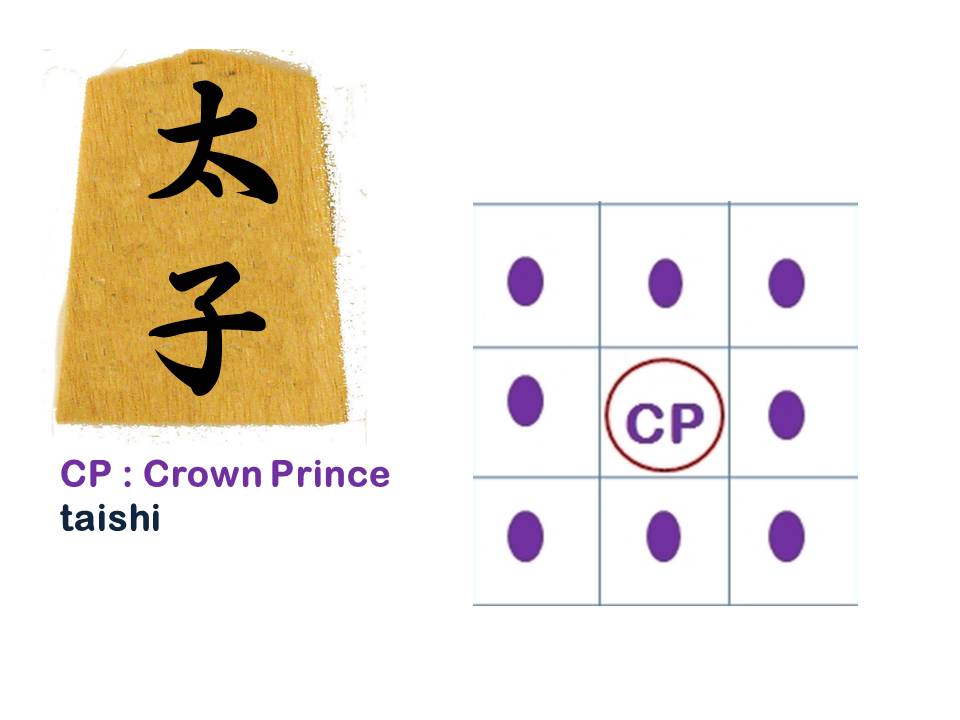
The Crown Prince can step one square in any direction, orthogonal or diagonal. A Taishi in play gives its owner a second royal piece that too needs to be mated along with the King, for the opponent to win the game. The Taishi has the same movement powers as the King (osho) - onesquare in any of the eight directions. Promotion : Emperor
The Right General can step one square in any direction except orthogonally right. It is called the right general because it guards the right side of the board.


Pieces & Movements
row 1   -   row 2 -   row 3   -   row 4   -   row 5 

Tai Shogi : row 3


The Side Chariot can move any number of free squares along one of the four orthogonal directions; or,  It can move one square diagonally behind.
The White Horse can move any number of free squares directly forward or backward; or, It can move any number of free squares diagonally forward.
The Ram’s-Head Soldier can move any number of free squares along either forward diagonal. An unpromoted ram's-head soldier that reaches the farthest rank is trapped.
The Violent Ox can move one or two squares in one of the four orthogonal directions.
The Cat Sword can move one square in one of the four diagonal directions. Because it cannot move orthogonally, a cat sword can only reach half the squares on the board.
The Blind Bear can move any number of free squares orthogonally backward; or, It can step one square in one of the four diagonal directions.
The Silver Hare can move any number of free squares diagonally backward; or, It can move one or two squares diagonally forward.
The Golden Deer can move any number of free squares diagonally forward; or, Limited range: It can move one or two squares diagonally backward.
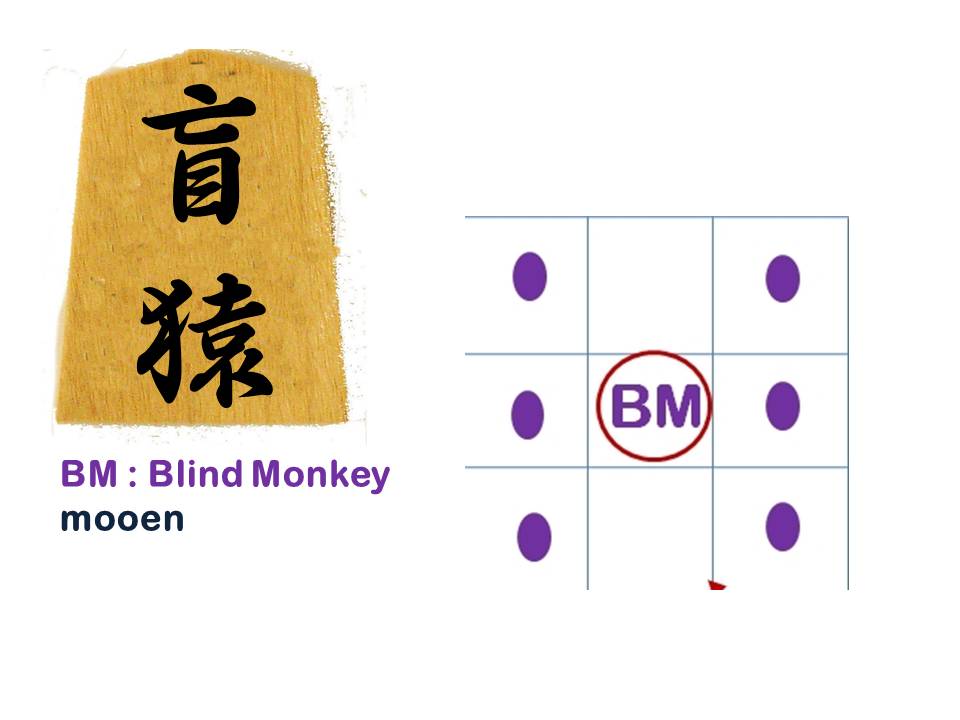
The Blind Monkey can step one square in one of the four diagonal directions or either orthogonal sideways.
Promotion : Mountain Witch
The Blind Tiger can step one square in any direction except orthogonally forward.
The Buddhist Devil can move one to three squares diagonally forward; or, It can move one square orthogonally sideways or directly backward.
Promotion : Guardian of the Gods
The Wrestler can move one to three squares along one of the four diagonal directions; or, It can move one square orthogonally sideways.
The Neighbour King can step one square in any direction, orthogonal or diagonal [except directly backwards?]
Promotion : Standard Bearer
The Guardian of the Gods can move one to three squares along one of the four orthogonal directions; or It can step one square diagonally [forward].
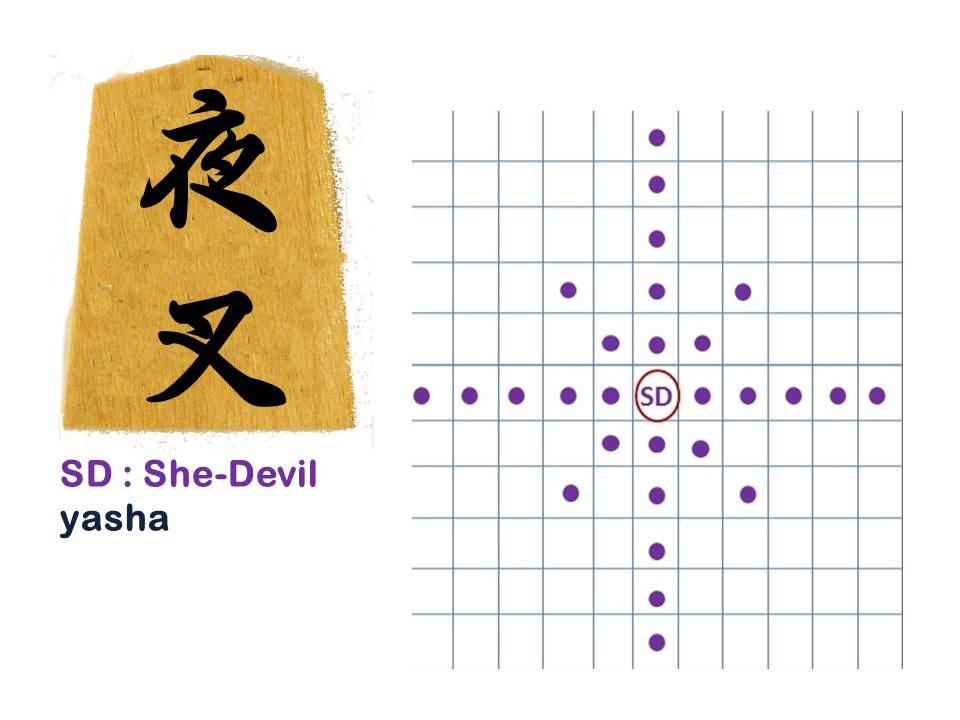
The She-Devil can move one or two squares along one of the four diagonal directions; or, It can move one to five squares along one of the four orthogonal directions.

Pieces & Movements
row 1   -   row 2 -   row 3   -   row 4   -   row 5 

Articles plus récents Articles plus anciens Accueil